
With freezing rain battering Montréal, we met virtually with McGill on Wednesday to present our global offer, that is, an offer on every item we have not yet agreed upon. including monetary items! This was a unique session, as there was less back and forth between the employer and ourselves than usual. Rather, we walked them through our monetary proposal, to which they will respond next week.
So what exactly was in our proposal?
Our proposal borrows language from the Unit 1 collective agreement on a number of areas. This collective agreement has been developed over many years (and a number of strikes) and so getting this language in a first contract would be a significant win. We also borrowed some language from existing university policies, as in the past McGill has shown openness to including policy language in our agreements. Especially regarding leaves and absences, we want a collective agreement that builds on what employees are already entitled to. Our article covering leaves defers to university policies where there are valuable pre-existing leaves or absences available to workers, and establishes these leaves for positions that did not have them, including bereavement (for the death of a family member), parental, maternal, paternal, and sick leaves.
From certification, Unit 3, the bargaining unit which will be covered by this contract, has covered a broader range of labour than Units 1 and 2. AGSEM’s other units are relatively homogenous: while the specific tasks can vary from department to department, they all perform very similar jobs to one another — Unit 2 covers invigilators, and Unit 1 covers teaching assistants. Unit 3, in contrast, was initially comprised exclusively of course-based academic support workers. In itself this contains a lot of different workers, undergrads, grad students, and non-student workers doing all sorts of course-based teaching support labour, and paid anywhere from minimum wage to the TA wage. A large part of the work this collective agreement does is to standardize these positions, which reduces McGill’s ability to underpay labour, or ask workers to take on labour they were not hired for.
In January of 2025, we added workers from the McGill Writing Centre (MWC) to Unit 3. While some MWC workers are graduate students who are part of the Writing Fellows program, most MWC workers have PhDs. In general, their work is more similar to that of course supervisors and professors—running graduate workshops, giving detailed feedback on research, designing courses and programs—than it is to the work of graders and teaching assistants. Consequently, the pay for many MWC workers was originally set to align with the pay of course lecturers, but this rate has not kept up with the raises those workers have seen. Since 2014, the pay of Course Lecturers has increased by nearly 60%, while workers like program developers in the MWC haven’t seen a raise at all.
In addition to wages, the work conditions of MWC workers are very different from other Unit 3 positions. Because of the unique nature of MWC workers in this Unit, we agreed with McGill to focus entirely on MWC during our March 25th bargaining session, at which both McGill & AGSEM will invite representatives from the MWC to the table to ensure that our agreement responds to the specific working conditions there.
Our monetary policy is divided into two different sub-fields. For the work attached to specific courses, our proposed rates of pay are as follows. In all cases, we have asked for an immediate and substantial raise from the beginning of the contract (Sept 2024 for academic casuals, and Jan 2025 for MWC workers) and a 3% raise for each subsequent year. This means we are fighting for retroactive pay for all workers who have worked since then.
Graders and course assistants receive pay equity with TAs: $37.46/hour as of September 2024
$38.46/hour as of September 2025
$39.61/hour as of September 2026
By reaching equity with TAs, these rates reflect the reality of this labour: grading as a TA is no different than grading as a grader, and the same applies to course assistants. They both require a similar degree of subject-matter expertise and should be compensated accordingly.
For Graduate Teaching Fellows, who often develop advanced pedagogical material that is then used by TAs and course lecturers, we proposed a wage reflecting the complexity of this work: $44.00 as of September 2024
$45.32 as of September 2025
$46.68 as of September 2026
The second subfield covers McGill Writing Centre employees. As discussed above, they are a unique group within this unit, and this is why the rates of pay are as high as they are. Many of these positions were originally paid at the course instructor rate, and our proposal is meant to catch these workers up. Graphos, a program run by the McGill Writing Centre, received national recognition as an outstanding graduate program, and so given the quality of the work they do, the subject matter expertise required, and the nature of McGill Writing Centre labour, we are proposing:
Programming Developer
Third Sunday of January 2025: $75.00
First Sunday of September 2025: $77.25
First Sunday of September 2026: $79.57
Tutorial Services Coordinator
Third Sunday of January 2025: $75.00
First Sunday of September 2025: $77.25
First Sunday of September 2026: $79.57
Thesis Writing Group Facilitator
Third Sunday of January 2025: $60.00
First Sunday of September 2025: $61.80
First Sunday of September 2026: $63.65
Commons Convener
Third Sunday of January 2025: $55.00
First Sunday of September 2025: $56.65
First Sunday of September 2026: $58.35
Graduate Writing Centre Fellow
Third Sunday of January 2025: $44.00
First Sunday of September 2025: $45.32
First Sunday of September 2026: $46.68
McGill Writing Centre Tutor
Third Sunday of January 2025: $44.00
First Sunday of September 2025: $45.32
First Sunday of September 2026: $46.68
Crucially, we have also proposed a clause stating that if any workers are currently paid above the rates we agree upon, they will continue to receive the higher rate until their employment ends, or the hourly rates listed reach parity with the rate of pay established by the Collective Agreement.
These monetaries were presented in a “global offer” with the rest of our non-monetary clauses that we still hadn’t reached a full agreement yet—such as Article 6 (Harassment & Discrimination) and Article 13 (Selection… our specific concern lies in ensuring that we have access to enrolment numbers in courses, which we created a new clause to ensure).
We reemphasized our position on Article 6: we would like explicit protections against harassment and deadnaming. While the employer may argue that our positions are “implicitly” included in the policy, increased clarity & explicit language help to ensure our members understand their rights. We will continue to push on this important issue.
Next session, we will be eagerly awaiting McGill’s response to our monetary (and non-monetary) proposal. Want to hear how much they value YOUR labour? Come join us! It will be a pivotal and important session. Sign up for our next bargaining session, March 18th, by using this form. You can see their counterproposal firsthand, understand what is truly at stake, and hold the employer accountable.
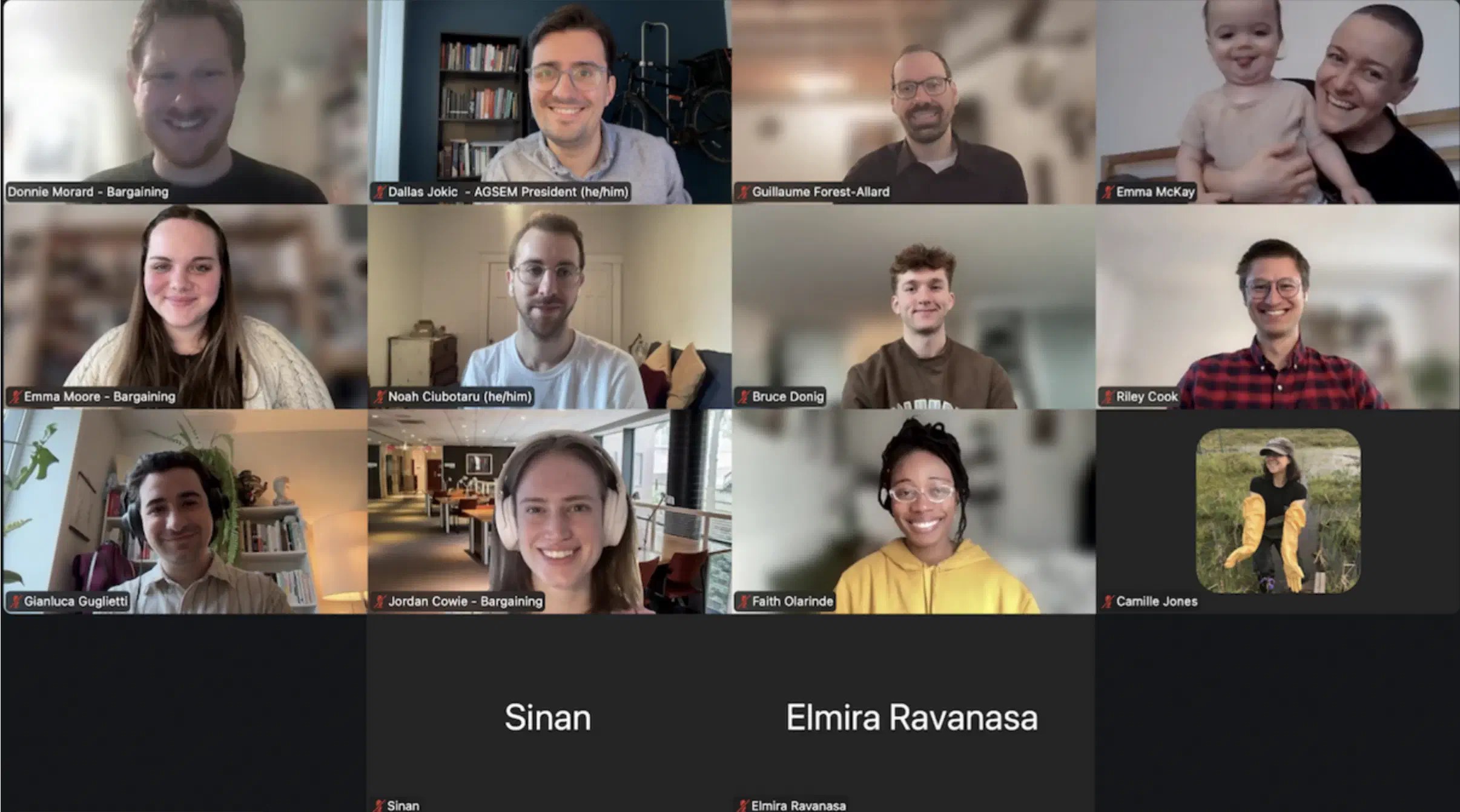
On our side of the table were Emma Moore (4th Year, Industrial Relations), Donald Morard (PhD Candidate, Grader, History), Jordan Cowie (2L Faculty of Law), and Guillaume Forest-Allard, our advisor from our affiliate union Fédération nationale des enseignantes et des enseignants du Québec (FNEEQ). We also had 9 members join for open bargaining.
Do you have thoughts and insights to provide (of course you do!)? Please don’t hesitate to reach out to bargaining.casual1@agsem-aeedem.ca with your insights, questions, or concerns!
And if you want to attend our upcoming bargaining sessions, please fill out this form to sign up and we’ll be in touch!
Love and solidarity, Your Bargaining and Bargaining Support Committee