
On Wednesday, March 18th, we met with McGill to receive their monetary response to our proposal, and it was bleak.
Regarding leaves and absences, McGill said they still need some time, so we expect to hear those items during one of the next two bargaining sessions. However, for non-monetary items, McGill separated their proposal into three distinct sections.
Starting with section one (articles 4 to 14), McGill proposed liberating 2 “average contracts” of 30 hours per semester. Liberations are commitments in a collective agreement that free up workers to be able to take on union work. In some unions this will just mean time off work, but in unions like ours it takes the form of money paid to the union that we distribute as honoraria among members taking on responsibility. AGSEM represents over 4000 workers, and it takes many people working daily to keep the employer accountable to established collective agreements, nevermind the bargaining of a new collective agreement. Without liberations, we would not be able to protect and advocate for our workers nearly as much.
Article 6 (Harassment) also found its way into section one. While we have been fighting for a very easy ask—explicit mention of deadnaming and misgendering as harassment—they are nothing short of intransigent.
For Article 11 (positions), McGill pared back much of our proposed specificity. Course assistants have responsibilities which overlap immensely with teaching assistants, so to make a meaningful distinction between the two jobs, we proposed limiting course assistantships to undergraduate students. McGill’s proposal scrapped this, stating that some workers in this unit are not students, and this work should not be limited to undergraduates.
The justification that was given related to the ‘level of autonomy’ that a TA has in comparison to a course assistant. This argument does not really hold water, however, because in both cases workers are attached to a course, and under the supervision of a course instructor. There were no examples given of instances in which a course assistant would have less autonomy than a teaching assistant. Furthermore, in the cases where the university may actually need to hire course assistants who are not current students, the union and the university can sign a letter of agreement to address these specific narrow cases.
Similarly, they removed graders from their proposed workload form, and made it a much simpler document which is compulsory only for contracts above 60 hours. Their reasoning was the administrative burden associated with workload forms, and that graderships are often straightforward, with someone hired to just grade this and that assignment.
The administrative burden is not a great argument, however, because they themselves suggested the possibility of workload forms being housed on Workday. In which case, submission would be no more of a burden than any other document one must complete when hiring a worker. Indeed, they do not cite the burden of collecting any other document when they hire someone…
The workload form’s main function is to clearly delineate, for both workers and course instructors, how much time each task will take compared to the time afforded in the contract. Often, a course instructor will not recognize how much time it takes to grade things in a satisfactory manner, or how much time it can take to field emails from both students and the course instructor. A workload form is, therefore, an immensely helpful document for accountability on the part of employers as well as employees. So while one McGill negotiator suggested finding a “threshold of complexity” beyond which a workload form is required, we see this as a surefire way to end up with workers going over their hours, and we will push for workload forms accordingly.
Indeed, this highlighted a deep tension in their proposal, for McGill made very clear they were deeply uncomfortable with job positions defined negatively—for instance, ‘a grader cannot hold office hours’. However, they wanted workload forms that were immensely flexible and unstructured. Putting two and two together, we could end up with workers hired to grade, yet asked to meet with students, or hold conferences. Such ‘flexibility’ inevitably helps the employer make unfair demands of our workers.
And now, part 2, Monetaries…
McGill pre-empted their monetary proposal with a presentation where they made the same old arguments about McGill’s economic woes. Given that McGill has spent $53,170,221.67 on internal and external security from 2019 to 2025, took on large construction projects despite a provincial government actively undermining university funding, and spent over 1 million dollars on legal fees to fight campus unions, McGill’s budgetary constraints seem more like mismanagement than a lack of available funds.
So, with this said, they proposed the following pay scheme. ‘Category’ is whether or not a position creates pedagogical material, and pay is inclusive of both vacation pay (6%) and statutory holiday pay (3.6%):
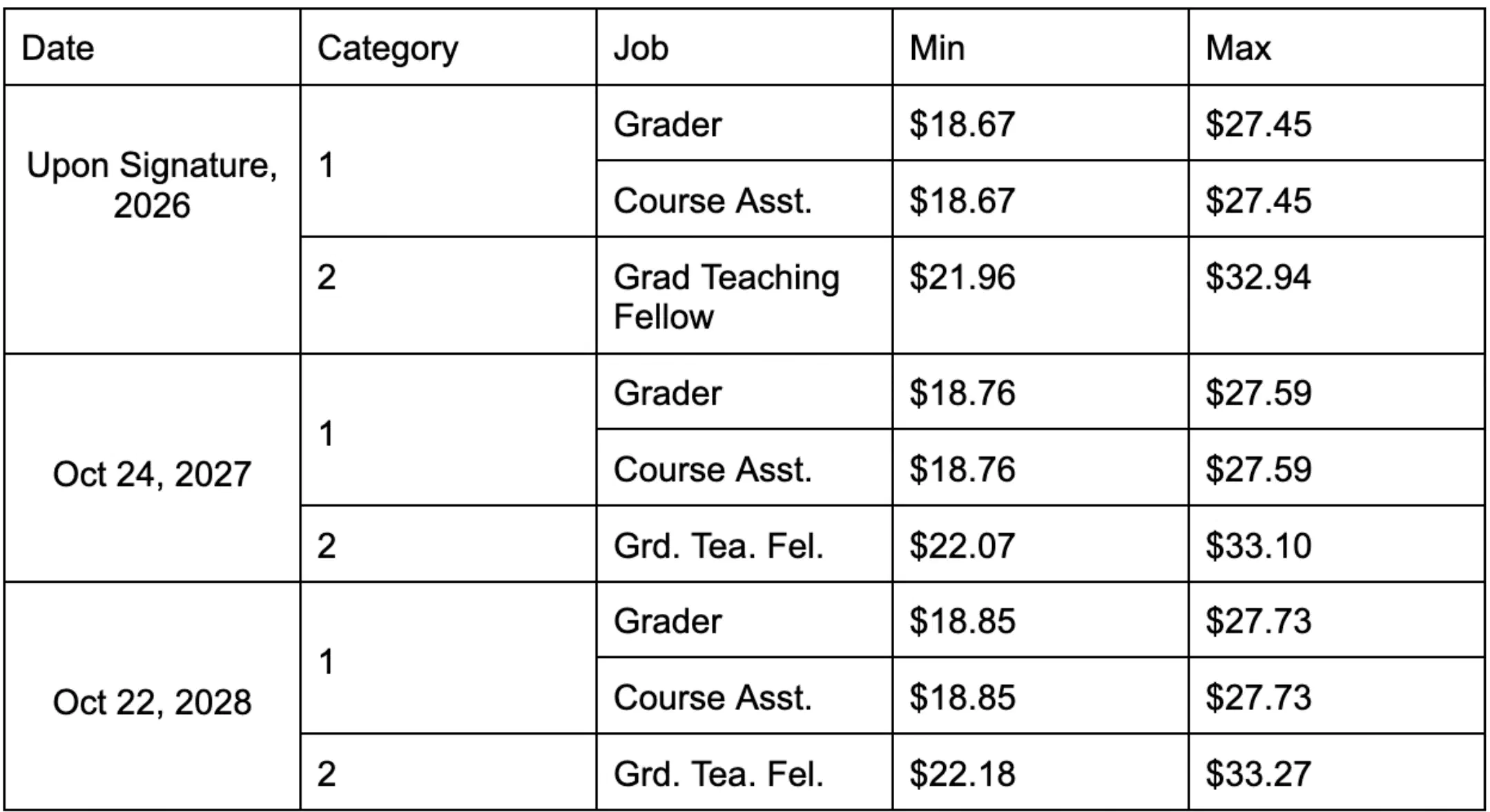
There is so much to say, but first let’s consider what they had to say about this. When compared with other universities, they said the low end is indeed quite low*.* However, they said that given minimum wage is $16.10, their $18.67 an hour is “a significant increase.”
But by including statutory holiday pay and vacation pay, they are effectively boosting their numbers, and then comparing with the minimum wage. The actual minimum wage, after the lowest vacation pay (4%) and stat holiday pay (3.6%) is $17.35/hour ($16.10x1.04x1.036=$17.35), so the actual minimum rate of pay they are offering is just $17 an hour, plus stat and vacation pay ($17/hr. 17x1.06x1.036=18.669). We also included these percentages in our proposed rate of pay, but our rate of pay was not 90 cents above minimum wage before stat. holiday and vacation pay, seeing as we proposed equity with TAs for graders and course assistants ($37.34/hour).
But what about inflation, you might ask, especially considering Quebec is facing the highest inflation rate in Canada! If you work as a grader next year, you would experience a raise of at least 9 cents per hour. That is a 0.5% pay increase, against an inflation rate of at least 2%. In essence, their proposal includes a pay cut, year over year.
And just how would they determine who gets paid the least compared to the most? It was argued that if you grade finals, you’d be paid higher than just grading assignments. But if you graded assignments AND finals, you’d be paid in the middle. This is not only unclear and contradictory, it doesn’t make any sense and leaves open the possibility of pitting workers against each other to accept the lowest end of the scale.
We are fundamentally opposed to a pay scale because it hides inequity as meritocracy. There is no clear distinction between different positions on this pay scale, and so no clear reason one might be paid more or less. McGill’s proposal requires the minimum pay, but says they can pay workers a bit more if they feel like it, this is not secure or fair, it is arbitrary and ripe for biased pay scales. A worker grading should not be paid less than another grader just because the person responsible for hiring them knows one better than the other.
Furthermore, their proposal removed any mention of workers retaining their current pay rates, and did not include any retroactive pay. Consequently, if this were agreed to, some workers would find their pay reduced dramatically; workers hired since the union was certified would also not experience retroactive pay increases, which we are fighting for. Unionized workers who worked in the Fall 2025 semester should see the benefits of unionization despite a collective agreement not being in force at the time of their employment.
For these many reasons, and innumerable other unmentioned reasons, our bargainers told McGill that this offer was insulting, and asked them to come back with an offer that is not based on pay scales.
McGill Writing Centre workers might wonder where they fell in all this! Well, because of the nuances of the Writing Centre, we had a bargaining session Wednesday, March 25th, dedicated to specifically work at the McGill Writing Centre. More information on that meeting will arrive with the next newsletter.

On our side of the table were Emma Moore (4th Year, Industrial Relations), Donald Morard (PhD Candidate, Grader, History), Jordan Cowie (2L Faculty of Law), and Guillaume Forest-Allard, our advisor from our affiliate union Fédération nationale des enseignantes et des enseignants du Québec (FNEEQ). We also had up to 8 members join for open bargaining.
Do you have thoughts and insights to provide (of course you do!)? Please don’t hesitate to reach out to bargaining.casual1@agsem-aeedem.ca with your insights, questions, or concerns!
And if you want to attend our upcoming bargaining sessions, please fill out this form to sign up and we’ll be in touch!
Love and solidarity,
Your Bargaining and Bargaining Support Committee